F1MATHS: What mileage reveals about the 2026 F1 field after Bahrain testing
The opening three‑day pre‑season test in Bahrain offered the first real glimpse into how well each Formula 1 team has adapted to the sweeping 2026 regulations. F1Technical's senior writer Balazs Szabo delivers his latest analysis.
While lap times are notoriously unreliable indicators at this stage, mileage is far more telling. It reflects reliability, operational sharpness, and how much data each team can take into the second test and the season opener in Melbourne.
Across the field, the eleven teams collectively completed over 20,000 km, but the distribution of that mileage paints a revealing picture of who is on top of their preparation — and who is already on the back foot.
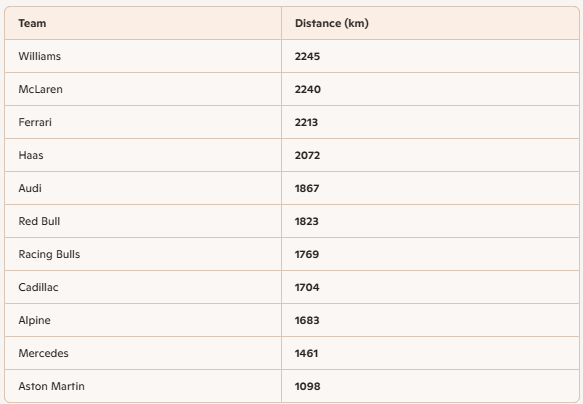
Williams sets the benchmarkWilliams emerged as the most productive team of the test, completing 2,245 km. Their strong reliability allowed them to maximise every session, giving the team a rich dataset to analyse. For a team that missed on the shakedown test in Barcelona, this level of consistency is a major early win.
McLaren and Ferrari close behindMcLaren followed closely with 2,240 km, only five kilometres shy of Williams. This aligns with the team’s own positive assessment of its progress, particularly in terms of correlation and reliability.
Ferrari completed 2,213 km, reinforcing Andrea Stella’s observation that the Scuderia looks competitive — especially in race‑simulation pace. Their strong mileage suggests a solid foundation heading into the next test.
Haas impresses with strong reliabilityHaas delivered one of the surprises of the week by completing 2,072 km, placing them fourth overall. For a team that often struggles with early‑season reliability, this is an encouraging sign.
Audi, Red Bull, and Racing Bulls form the midfield packAudi logged 1,867 km, a respectable total for a team still settling into its new identity. Red Bull completed 1,823 km, placing them sixth. While their mileage is lower than expected, their performance runs have already drawn attention across the paddock — suggesting they focused more on optimisation than endurance.
Racing Bulls added 1,769 km, continuing their trend of dependable running.
Cadillac and Alpine in the lower midfieldCadillac completed 1,704 km in their first official test as a new entrant, a solid start for a team building its infrastructure from scratch.
Alpine followed with 1,683 km, leaving them with work to do but still within a reasonable range.
Mercedes completed only 1,461 km, the second‑lowest total. George Russell described the test as “eye‑opening,” and the mileage deficit underscores the challenge they face in understanding their new package.
Aston Martin recorded the lowest total with 1,098 km, reflecting the issues both Fernando Alonso and Lance Stroll acknowledged throughout the week. The team openly admits it is behind schedule, and the mileage shortfall confirms that impression.