F1MATHS: How many laps did the five engine manufacturer complete in Bahrain?
The first Bahrain test of the 2026 Formula 1 season offered an early look at how each power‑unit supplier handled the demands of the new regulations. F1Technical's senior writer Balazs Szabo delivers his latest analysis.
Mileage is one of the most reliable indicators of early‑season readiness, and the totals reveal a striking spread between manufacturers.
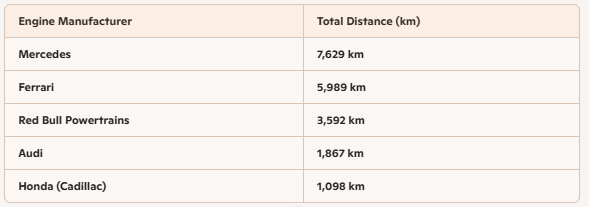
Mercedes Leads With 7,629 kmMercedes‑powered teams completed 7,629 km, the highest total of any engine supplier. This reflects strong reliability across their customer teams, even if the works Mercedes squad itself had a more challenging test.
The sheer volume of running gives Mercedes valuable data as they refine their 2026 hybrid package.
Ferrari Close Behind With 5,989 kmFerrari engines accumulated 5,989 km, placing them second overall. Both Ferrari and Haas delivered strong reliability, and the Scuderia’s race‑simulation pace drew attention throughout the paddock. This mileage confirms that Ferrari enters the next test with a solid foundation.
Red Bull Powertrains Completes 3,592 kmRed Bull’s engine programme logged 3,592 km, a respectable total that reflects a balance between reliability work and performance‑focused testing.
While not the highest mileage, Red Bull’s early pace has already been described as “pretty scary” by rivals, suggesting they prioritised optimisation over endurance.
Audi Records 1,867 kmAudi, now operating as a full works manufacturer, completed 1,867 km. This places them in the midfield of the engine mileage table. For a team still integrating its new power‑unit structure, the total represents a steady start.
Honda completes 1,098 kmThe Honda‑Aston Martin partnership logged 1,098 km, the lowest total among the five manufacturers. Fernando Alonso explained that Honda’s power unit appeared to be struggling more than others during the opening days of testing.
The Spaniard noted that his Aston Martin was losing significant time on the straights and was visibly compromised in deployment. He described the situation as “not ideal” and said that the deficit was “easy to see” when comparing speed traces.