F1MATHS: How did the Mercedes W17 perform during Russell's race simulation?


Mercedes closed the opening pre‑season test in Bahrain with a full race simulation from George Russell, offering the first uninterrupted look at the W17’s long‑run behaviour. F1Technical's senior writer Balazs Szabo delivers his latest analysis.
Across 58 laps, Russell completed three distinct stints, progressing from soft (C3) to medium (C2) to hard (C1) tyres. The run provides an initial look at tyre degradation, fuel load effects, and the Mercedes W17's balance over long distances.
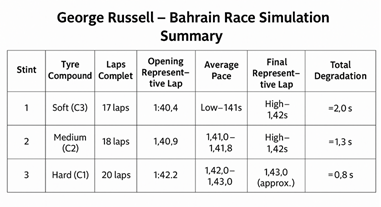
Stint 1 – Softs (C3): Early pace, predictable fadeRussell opened the simulation on the soft compound, completing 17 timed laps before boxing. His first representative lap settled at 1:40.4, and he maintained low‑1:40s for the opening phase.
The stint’s most notable feature is how quickly the softs began to slide away: by lap 10, his times had drifted into the 1:41s, and by lap 15 he was circulating in the 1:42 range.
The degradation curve is clear: the difference between his early‑stint pace and his final lap on the C3s is roughly 2.0 seconds, a typical pattern for a high‑degradation track like Bahrain. His in‑lap on lap 18 was logged at 1:43.5, confirming the tyres were well past their peak.
This opening stint suggests the W17 is gentle enough on the softs to avoid catastrophic drop‑off, but not gentle enough to make the C3 a viable race tyre in normal conditions.
Stint 2 – Mediums (C2): The most consistent phaseAfter a quick pit stop on lap 19, Russell switched to the medium compound, and this is where the simulation becomes most encouraging for Mercedes.
His first flying lap on the C2s clocked in at 1:38.6, 1.1 seconds quicker than his quickest lap time during his opening soft-tyre stint. More importantly, the medium stint showed remarkable stability: for more than a dozen laps, Russell circulated between 1:39.0 and 1:39.9, with only minor fluctuations.
The degradation profile here is much flatter. By the time he approached the end of the stint, his times had only drifted into the mid‑1:40s, meaning the total drop‑off across the stint was roughly 1.3 seconds—significantly lower than on the softs.
Stint 3 – Hards (C1): Stable but no big jump in performanceRussell’s final stop came on lap 38, switching him to the hardest compound for the closing phase. His first representative lap on the C1s was 1:38.2, immediately quicker than any of his previous lap times.
The hard‑tyre stint is defined by consistency rather than speed. Russell hovered between 1:39.0 and 1:40.0 for most of the run, with only small oscillations. The degradation curve is the flattest of all three stints.